The red meat processing industry has always faced a challenge that’s critical but largely invisible to the public: wastewater. Behind the scenes of every steak or sausage lies a heavy-duty treatment process designed to manage the fats, oils, solids and nutrients that processing plants generate on a daily basis. For decades, the solution has involved heavy chemical dosing – but that’s changing.
Now, a natural alternative is stepping into the frame. And it’s doing more than keeping the water clean. It’s improving operational efficiency, cutting emissions, and generating value from waste. This is the promise of Tanfloc – a plant-based coagulant derived from sustainably harvested Acacia bark, and one of the most effective tools a processor can use to future-proof its wastewater treatment operations.
A recent, full-scale trial at a red meat processor (RMP) in Inverell, NSW, offers hard proof that this isn’t just a “green” idea. It’s a better idea – on every level.
Key Takeaways
- A 30-day full-scale trial at a red meat processor (RMP) in NSW proved that Tanfloc significantly outperforms traditional coagulants in wastewater treatment.
- Tanfloc achieved removal rates of 94% for FOG, 86% for TSS and 63% for BOD, reducing the load on downstream treatment and improving effluent quality.
- The natural, plant-based coagulant enabled increased recovery of third-grade tallow, turning waste into a sellable by-product.
- Unlike metal-based coagulants, Tanfloc is non-toxic, biodegradable, and does not require pH correction, lowering operational costs and chemical handling risks.
- A payback period of less than 12 months was demonstrated through increased efficiency, reduced chemical use, and added by-product revenue.
- The success at RMP offers a replicable model for meat processors across Australia seeking to improve compliance, reduce costs, and meet environmental targets.
From Tanafloc to Tanfloc: A Clarification
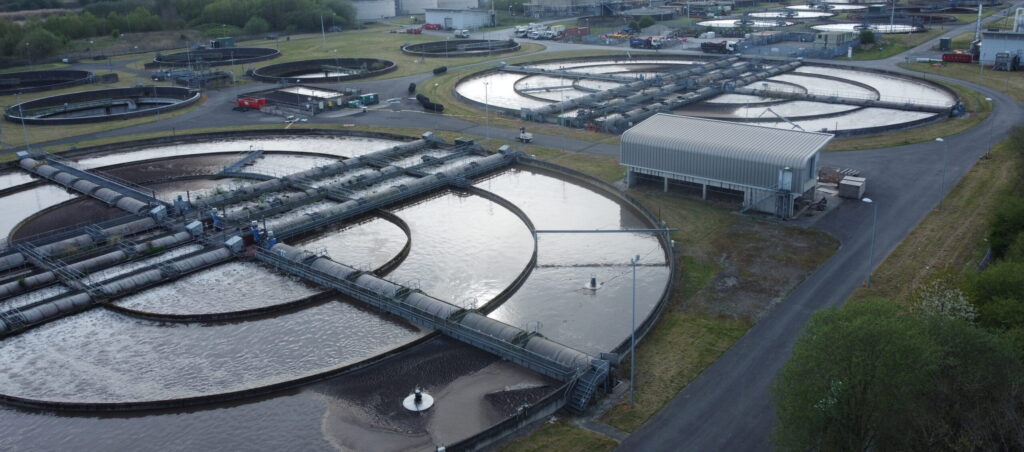
An aerial shot by a drone of the wastewater treatment plant with the river in the background
Before we get into the findings, a quick point of clarification. Tanafloc is the company supplying the technology. Tanfloc is the product: a carbon-negative, tannin-based coagulant designed to replace traditional, metal-based alternatives in Dissolved Air Flotation (DAF) systems. Tanfloc works by aggregating suspended solids and impurities, allowing them to be easily separated from water using microbubbles in DAF units.
But this isn’t just another chemical alternative. Tanfloc is fundamentally different – both in how it performs and what it’s made from.
The Challenge at RMP: High-Strength Wastewater, No Chemical Dosing
At the time of the trial, the RMP site had no prior chemical dosing system in place. Their 50 m³ pre-DAF tank was managing wastewater flows reaching up to 115 m³/h during peak hours, far beyond its designed capacity. Peak flows were putting a huge strain on turbidity control and suspended solids removal, while site-wide pH fluctuations (particularly after cleaning cycles) made reliable treatment inconsistent.
There was a clear gap between the plant’s operational targets and what its infrastructure could consistently achieve. The objective of the trial was simple: install an automated chemical dosing system, trial Tanfloc for a sustained period, and assess performance across technical, financial and environmental metrics.
A Ground-Up Optimisation Strategy
The project was carried out by Tessele Consultants in partnership with Tanafloc Australia and the RMP site team. It began in May 2024 with a benchmarking visit: jar testing, turbidity readings and a full inspection of the DAF system. Even at this early stage, Tanfloc showed strong coagulation potential – particularly when supported by polymer flocculant EM533.
But to give Tanfloc a fair trial, the site needed more than chemicals. It needed infrastructure.
Key upgrades included:
- Automated dosing systems for both coagulant and polymer
- Real-time dosing adjustments linked to DAF inflow rates
- Polymer make-down skid and agitation tanks for consistency
- Bunding and containment for IBCs
- Functional control descriptions for integration with SCADA
The equipment was delivered, installed and commissioned in time for a second site visit and 30-day trial starting November 2024.
Trial Findings: Measurable, Repeatable, Impactful
During the trial, samples were collected before and after DAF treatment. Analysis was carried out by certified external laboratories, and results were benchmarked against historical values, including:
- Pre-upgrade (no dosing): Jan 2023 – April 2024
- Post-upgrade, no dosing: Aug – Nov 2024
- Post-upgrade, Tanfloc dosing: Dec 2024 – Jan 2025
The impact was immediate and undeniable.
Contaminant Removal Rates
| Parameter | Removal Efficiency |
| Total Suspended Solids (TSS) | 86% |
| Fats, Oils & Grease (FOG) | 94% |
| Biochemical Oxygen Demand (BOD) | 63% |
| Total Nitrogen (TN) | 55% |
| Total Phosphorus (TP) | 58% |
| Total Dissolved Solids (TDS) | 21% |
This is not marginal performance. This is transformational performance – especially when you consider that none of these results required pH buffering or acid correction to keep the process stable.
Sludge Recovery: Turning Waste Into Value

One of the most overlooked opportunities in wastewater treatment is sludge quality. In this trial, sludge was not just easier to manage – it was richer.
Thanks to Tanfloc’s high efficiency in removing FOG and TSS, the recovered sludge yielded a significantly higher volume of third-grade tallow – a low-value but nonetheless sellable by-product. Operators reported improved tricanter recovery and a visible difference in the consistency and colour of the tallow, which appeared more yellow and less contaminated with solids.
This mattered not only from a resource recovery standpoint but from a safety and hygiene perspective too. Cleaner sludge means less odour, less handling risk, and easier downstream processing – whether for compost, biogas, or landfill.
Operational Upsides: Less Energy, More Stability
By removing up to 63% of BOD at the DAF stage, Tanfloc indirectly reduced the oxygen demand for downstream aeration. Less oxygen demand means lower energy use, and lower energy use means cost savings. This wasn’t a side benefit. It was built into the economic analysis.
Moreover, Tanfloc required no drastic pH adjustment. Compared to metal-based coagulants, which often require substantial acid or base dosing to remain within operating pH windows, this is a major plus. Fewer chemicals, less handling, safer operations.
Financial Case: Payback in Under 12 Months
A detailed cost-benefit analysis was conducted using site-specific operational data. It modelled several scenarios and assumed a baseline of no chemical dosing vs full-scale Tanfloc implementation.
Key assumptions included:
- Dosing volumes adjusted for flow and turbidity
- Chemical costs based on market rates
- Maintenance savings from reduced corrosion
- Revenue from recovered tallow
Payback Period: Less than 1 year
This makes Tanfloc one of the few treatment upgrades that offers both operational and financial ROI – a compelling case for decision-makers balancing compliance, cost and sustainability.
The Broader Picture: Sustainable Wastewater for a Changing Industry 
Let’s zoom out.
The Australian red meat industry is under increasing pressure to reduce emissions, improve water reuse, and demonstrate sustainable credentials to both regulators and consumers.
Tanfloc supports every one of these goals:
Environmental Impact
- Biodegradable Coagulant: No residual metals or toxic residues
- Carbon-Free Coagulant: Manufactured without fossil-based chemistry
- Chemical-Free Coagulant: No alum, ferric chloride or polyaluminium chloride
- Tannin-Based Coagulant: Derived from renewable, traceable Acacia sources
Regulatory & Compliance
- Easier to meet EPA effluent discharge standards
- Reduced risk of heavy metals in biosolids
- No impact on beneficial reuse pathways for treated effluent or sludge
Safety
- Non-toxic and non-corrosive
- Safer for operators handling dosing systems
- Lower transport and storage risks compared to acidic coagulants
Sector-Wide Implications
This isn’t a red meat story. It’s an industrial story.
The same benefits proven at RMP can be replicated in other sectors where wastewater is complex, nutrient-rich and difficult to treat:
- Dairy Industry Coagulant: Excellent for treating whey-rich effluent
- Beverage Industry Coagulant: Effective in sugar, fruit and yeast-heavy waste
- Aquaculture Coagulant: Helps stabilise nutrient cycles in RAS systems
- Textile Industry Coagulant: Removes dyes, starches and fibres
- Petrochemical Wastewater Coagulant: Binds hydrocarbons and organic sludge
- Municipal and Construction Coagulant: Safe for broad application with minimal toxic risk
Whether your site is in Perth, Brisbane or the Gold Coast, the availability of a water purification coagulant that’s sustainable, efficient and cost-effective has never been more relevant.
The Final Verdict
The Tanfloc trial at RMP isn’t just a nice story about sustainability. It’s a wake-up call for an industry ready for change.
Tanfloc outperformed conventional coagulants in every way that matters: removal rates, sludge quality, energy use, chemical safety, and cost recovery. And it did all of this without increasing operational complexity or risk.
For meat processors navigating a future of carbon accounting, tighter regulation and rising operational costs, Tanfloc is more than an upgrade. It’s a step into a smarter, more sustainable future.
And the best part?
It’s available now.